
The Caribbean Court of Justice has ruled that Suriname breached the treaty rights of a Trinidad and Tobago national by denying him direct access to legal counsel while he was held in pre-trial detention under restrictive orders.
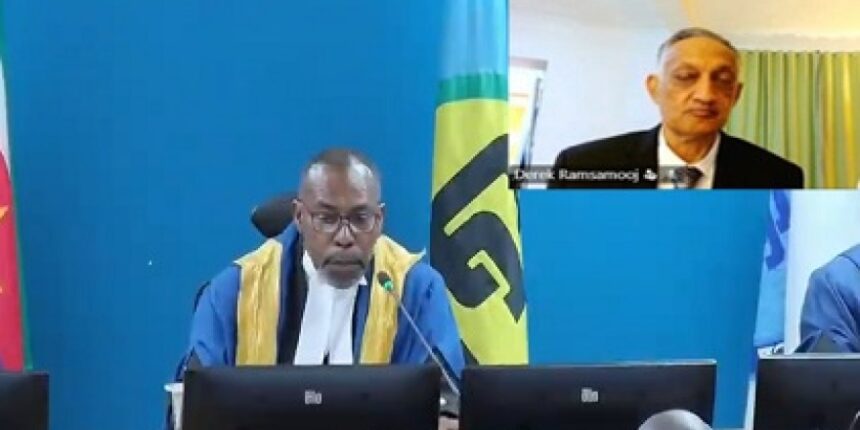
In a judgment delivered on Monday, the Court, sitting in its Original Jurisdiction, found in favour of Trinidadian political consultant Derek Anand Ramsamooj in the matter Derek Anand Ramsamooj v The State of Suriname and the Caribbean Community [2026] CCJ 2 (OJ). The Court awarded Ramsamooj US$30,000 in damages after determining that his detention conditions unlawfully impeded his right to freedom of movement under the Revised Treaty of Chaguaramas.
Ramsamooj had travelled regularly to Suriname since 2014 to provide consultancy services linked to the former Surinamese administration. However, on 6 October 2020, authorities seized his passports and detained him a day later as part of an investigation into alleged government fraud.
During his detention, Ramsamooj was held under two consecutive eight-day “beperking” orders issued under Article 40(2) of Suriname’s Code of Criminal Procedure. The orders denied him direct access to legal representation while he was interrogated in Dutch through a translator. A Dutch-language statement he later signed was subsequently treated as a confession in court proceedings.
The CCJ found that the restriction orders deprived Ramsamooj of legal counsel during critical stages of the investigative process, including police questioning and any attempt to challenge either the detention itself or the legality of the restriction orders.
In its ruling, the Court held that treaty rights enjoyed by CARICOM nationals, including freedom of movement and the right to provide services, must exist alongside minimum human rights protections. Among those protections, the judges identified the right of an accused person to access legal counsel of their choosing as a fundamental standard recognised throughout CARICOM member states.
The Court also ruled that Article 40 of Suriname’s Code of Criminal Procedure, insofar as it allows the denial of access to legal counsel during the investigative stage without adequate safeguards, falls below the minimum human rights standard required under Community law.
Suriname had argued that the Court lacked jurisdiction over alleged human rights violations and maintained that the Charter of Civil Society for the Caribbean Community was not legally binding. The state also sought to justify the restrictions under provisions of the Revised Treaty of Chaguaramas relating to public order and safety.
However, the CCJ rejected those arguments, stating that the Charter, while not binding in itself, could still assist in interpreting Community law and identifying the general principles underpinning treaty rights.
The Court further held that Ramsamooj was not required to prove discrimination based on nationality in order to establish a breach of his treaty rights.
Although the judges declined to award damages for medical expenses or issue declarations concerning the right to provide services, they accepted uncontested expert medical evidence that Ramsamooj suffered a coronary event, a stroke, and significant worsening of coronary artery disease during his detention. The Court stated that the conditions of detention would have certainly contributed to the deterioration of his health.
In addition to awarding damages, the Court declared that any reliance in future criminal proceedings on admissions or confessions obtained during the unlawful detention would itself breach Community law. However, Suriname remains free to continue proceedings using evidence obtained independently of the detention.
Costs were also awarded to Ramsamooj.
The panel hearing the matter included CCJ President Adrian Saunders Anderson and Justices Rajnauth-Lee, Barrow, Jamadar, and Ononaiwu.
Ramsamooj was represented by Senior Counsel Justin Phelps alongside Navindra Ramnanan, Milton Castelen, and Chase Pegus. Caribbean Community participated in the matter as amicus curiae, represented by Senior Counsel Lisa Shoman, Radha Permanand, and O’Neil Francis.