

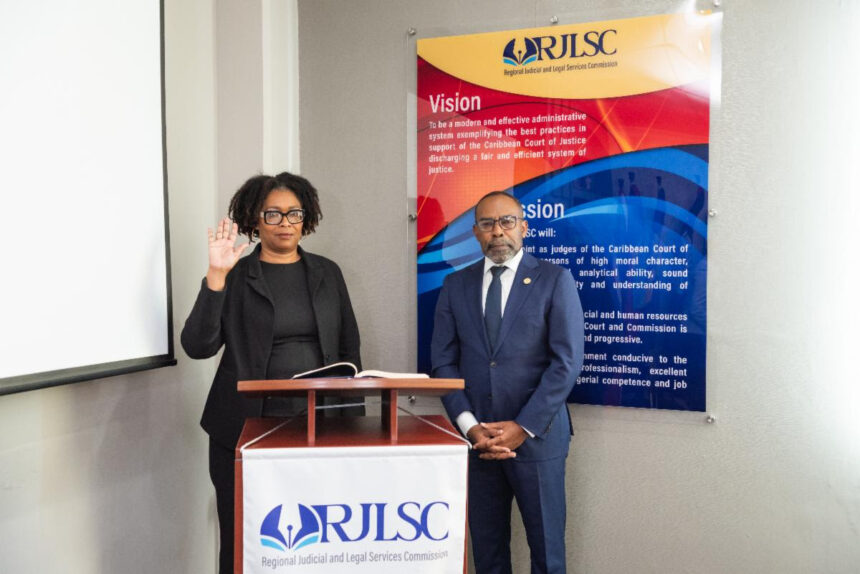
The Regional Judicial and Legal Services Commission (RJLSC) has appointed two new commissioners, marking a significant step in reinforcing judicial governance across the Caribbean Community.
Elleson M. Fraenk of Suriname and Anthony A. Olton of Barbados were sworn in on March 11, 2026, in a ceremony conducted under the provisions of the Revised Treaty of Chaguaramas. The oath of office was administered by Winston Anderson, who also chairs the Commission.
The appointments come at a time when regional legal institutions are facing increasing demands to adapt to evolving governance challenges, including the need for stronger institutional frameworks and greater harmonisation across jurisdictions within Caribbean Community (CARICOM).
Fraenk, an attorney-at-law and founder of Vision Legalis Advocaten N.V., brings extensive experience in corporate, labour, and intellectual property law. She currently serves as President of the Suriname Bar Association and is also the Honorary Consul of Sweden in Suriname. Her background in civil law, combined with her engagement in regional and international legal networks, is expected to contribute to the Commission’s work in bridging legal traditions within CARICOM.
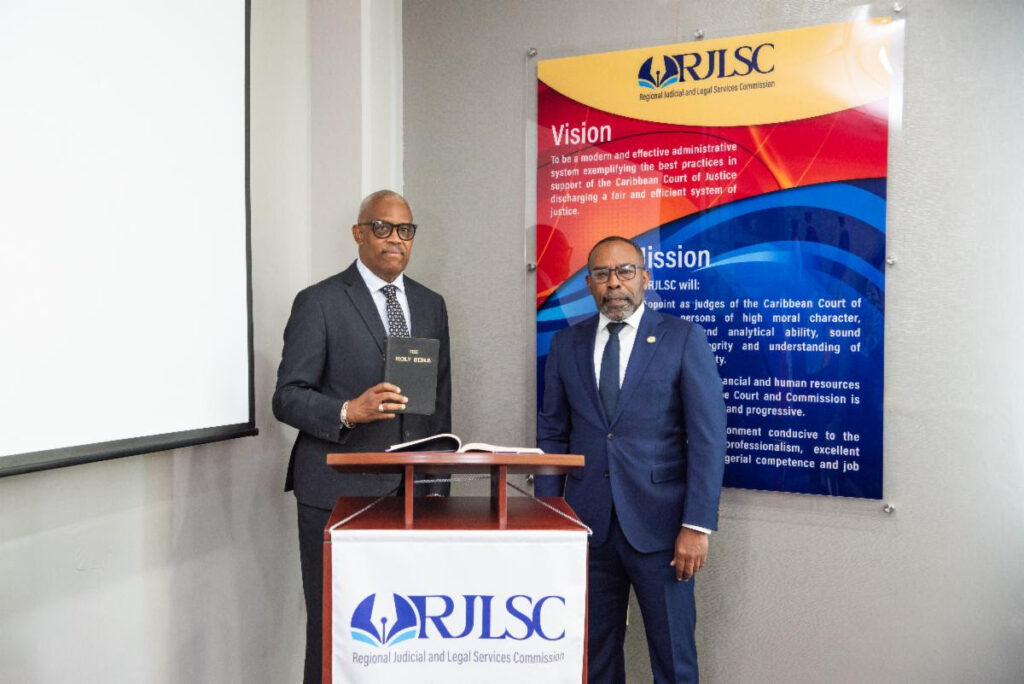
Olton, a Barbadian leadership consultant and Principal Consultant at The Potter Centre, brings nearly 30 years of experience in organisational development and governance. He is also Chair of the Administrative, General and Professional Service Commission of Barbados and serves on several national bodies, including the Judicial and Legal Services Commission and the Barbados Accreditation Council. His experience in leadership development and public sector reform is seen as an asset to the RJLSC’s mandate.
The two new commissioners replace former members Damien Dublin and Jacqueline Samuels-Brown, whose terms recently concluded.
The RJLSC, which plays a central role in appointing judges and supporting the administration of justice within the Caribbean, said it expects the new commissioners to bring valuable expertise and regional perspective as it continues its work to strengthen judicial systems across member states.