
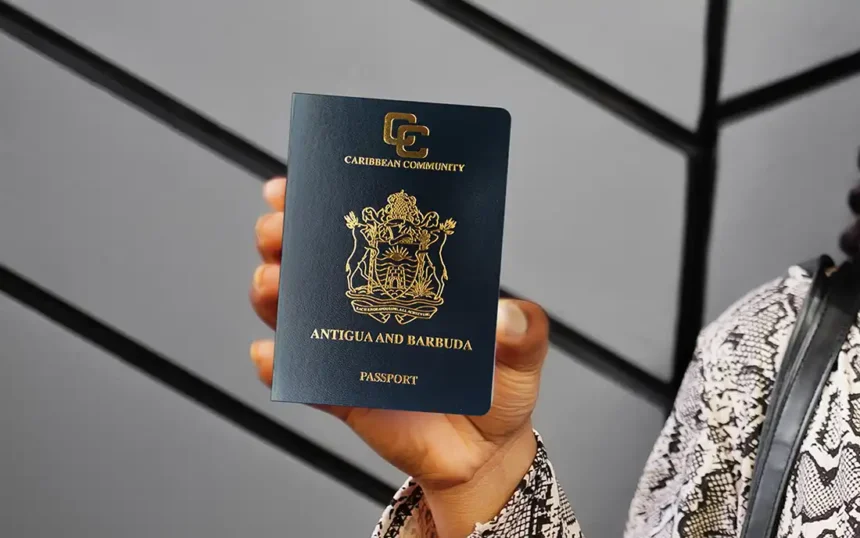
The Government of Antigua and Barbuda has formally reacted to a U.S. presidential proclamation that will suspend issuance of several categories of United States visas to its nationals, effective 12:01 a.m. on January 1, 2026. The move forms part of a broader expansion of U.S. immigration restrictions affecting multiple countries, including Antigua and Barbuda and Dominica, tied to concerns over national security and citizenship-by-investment (CBI) programs.
In a statement released today, Prime Minister Gaston Browne expressed deep disappointment that Antigua and Barbuda was included in the proclamation on the asserted basis that its Citizenship by Investment Programme “has historically operated without a residency requirement.” He said this characterization “does not reflect the present reality of our laws.”
Over the past year, according to the Government, Antigua and Barbuda has worked “closely and constructively” with multiple U.S. government departments to strengthen safeguards in the CBI programme — including due diligence, transparency, enforcement, and information sharing — to ensure no threat to U.S. security. Parliament has recently approved comprehensive new legislation that introduces a mandatory 30-day physical residency requirement in Antigua and Barbuda for those seeking citizenship through investment, the government said.
“It is therefore an error to state that Antigua and Barbuda’s Citizenship by Investment Programme operates without a residency requirement,” the statement added.
According to the White House proclamation, the restrictions on nationals of Antigua and Barbuda cover immigrant visas and key nonimmigrant categories — including B-1 (business), B-2 (tourism), combined B-1/B-2, and student visas (F, M, and J) — citing historic operation of CBI without residency as a factor in the decision. The White House
Upon notification of the proclamation, Antigua and Barbuda’s Ambassador to the United States, Sir Ronald Sanders, immediately contacted the U.S. Department of State, where officials reportedly expressed surprise at the proclamation’s issuance and confirmed they had received no prior notice. Ambassador Sanders has since initiated arrangements for urgent high-level engagement with both the State Department and the White House to clarify the facts and seek a resolution aimed at restoring normal U.S. visa access for Antiguan and Barbudan nationals.
In parallel, Prime Minister Browne said he is writing directly to U.S. President Donald J. Trump and Secretary of State Marco Rubio, offering “the full engagement and cooperation of the Government of Antigua and Barbuda” to address any U.S. concerns and take all reasonable steps to facilitate the restoration of visa services.
The government’s statement reaffirmed the long-standing relationship between Antigua and Barbuda and the United States, noting that ties between the two nations predate their respective independence eras and are grounded in shared democratic values, strong people-to-people links, and substantial bilateral trade. “Antigua and Barbuda values its relationship with the United States,” the government said, pledging to act “on the basis of mutual respect, cooperation, and accurate understanding.”
Regional counterparts are also engaging Washington for clarity. The Government of Dominica, which is similarly affected by the U.S. restrictions, has said it is actively engaging with U.S. diplomatic officials to determine the full implications of the measures for Dominican nationals and visa holders.
As the diplomatic exchanges continue, the expanded U.S. proclamation has sparked concern across the Caribbean, particularly among countries operating citizenship-by-investment schemes, which Washington has increasingly scrutinized as part of its broader immigration and national security policy.