

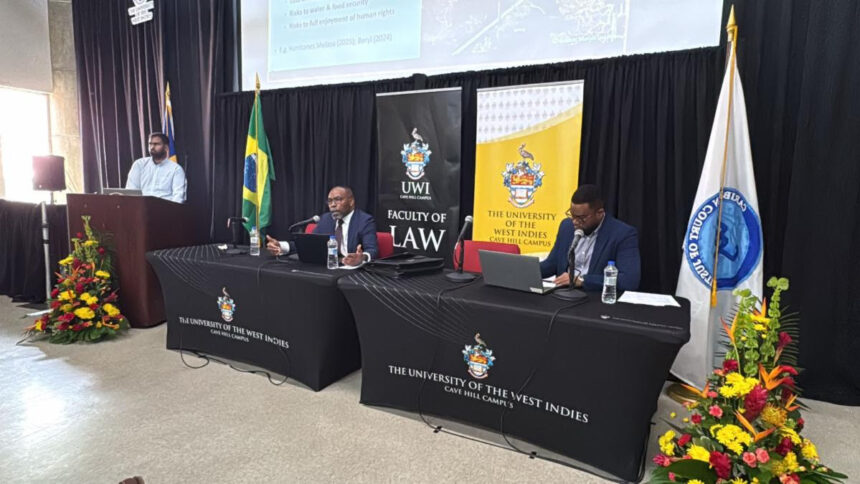
President of the Caribbean Court of Justice, Winston Anderson, has underscored the urgent need for stronger international legal mechanisms to address climate change, as he delivered the keynote address at a major regional conference in Bridgetown on Friday.
The address formed part of the international conference, “Climate Change Advisory Opinions from International Courts: Exploring Synergies and Implications,” hosted by the University of the West Indies, Cave Hill campus, in collaboration with the International Union for Conservation of Nature World Commission on Environmental Law.
Held over two days at the Ralph Carnegie Law Lecture Theatre, the conference brought together jurists, academics and legal practitioners to examine how international courts are increasingly shaping responses to the global climate crisis through advisory opinions.
In his keynote, Justice Anderson highlighted the growing importance of international judicial systems in clarifying the legal obligations of states and advancing climate justice. He pointed to the particular vulnerabilities of small island developing states, especially in the Caribbean, which continue to face intensifying climate impacts, including stronger hurricanes, rising sea levels and threats to food and water security. He referenced the devastation caused by Hurricane Melissa as a recent example of the region’s exposure.
While noting that Caribbean jurisprudence has already recognised environmental rights as human rights, Anderson argued that existing regional legal frameworks are insufficient to address the transnational nature of climate change. He stressed that legal systems must evolve to ensure equitable responses, including accessible remedies to help vulnerable countries recover from climate-related loss and damage.
Central to his address was a proposal for the creation of an International Climate Injuries Compensation (ICIC) Fund, which would be financed by corporations responsible for significant greenhouse gas emissions. Anderson said such a mechanism could help overcome the challenges of assigning liability to major emitters, while providing a more efficient alternative to lengthy and complex litigation.
Under the proposal, an international convention would mandate contributions from corporations based on their annual emissions, with participating states responsible for monitoring and reporting. He said the initiative aligns with the “polluter pays” principle and existing norms of international law requiring states to prevent environmental harm beyond their borders.
Justice Anderson has been advancing the proposal in recent months, including at a regional forum hosted by the Caribbean Natural Resources Institute in January and at a climate and human rights seminar in Brazil earlier this week.
The conference, organisers said, reflects a growing recognition of the role of international law in confronting climate change and underscores the CCJ’s continued engagement in global legal discourse on pressing transnational issues.