

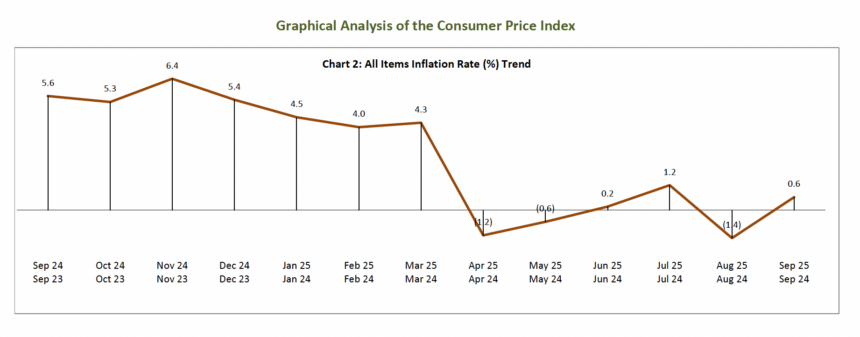
Antigua and Barbuda recorded a modest increase in consumer prices over the twelve months ending September 2025, even as prices declined on a month-to-month basis, according to the latest Consumer Price Index (CPI) released by the Statistics Division within the Ministry of Finance and Corporate Governance.
The CPI rose by 0.6 percent year-on-year, driven by price increases in nine of the twelve major expenditure categories. The most significant contributors to the annual increase were Education, Restaurants and Hotels, Health, and Alcoholic Beverages, Tobacco and Narcotics. Education costs recorded the sharpest rise, increasing by 13.1 percent over the twelve-month period, while prices in Restaurants and Hotels climbed by 9.7 percent. Communication services also contributed to the upward movement, rising by 1.5 percent.
Food and Non-Alcoholic Beverages registered a marginal increase of 0.3 percent over the year. Within this category, food prices edged up by 0.1 percent, while non-alcoholic beverages increased by 1.1 percent. The rise in food prices was largely influenced by higher costs for vegetables, bread and cereals, and food products not elsewhere classified. Vegetable prices rose by 6.2 percent, with frozen, preserved, and processed vegetables showing the largest increase at 9.2 percent. Bread and cereals increased by 1.2 percent, driven by higher prices for other cereals and flour products, as well as rice.
These increases were partially offset by notable declines in several food categories. Prices for fish and seafood fell by 7.4 percent, while fruit prices declined by 5.3 percent. The index for milk, cheese, and eggs also dropped by 2.5 percent over the year, tempering overall food inflation.
Excluding food and energy, the All Items Less Food and Energy index rose by 0.8 percent year-on-year, reflecting higher costs in education, hospitality services, and communication.
Despite the annual increase, consumer prices declined on a monthly basis. The CPI fell by 0.3 percent in September compared with August 2025, signaling easing price pressures during the month. The Food and Non-Alcoholic Beverages index declined by 0.1 percent, while the All Items Less Food and Energy index decreased by 0.4 percent.
Within the food category, prices edged up slightly by 0.1 percent during the month, with four of the nine major supermarket food groups recording increases. Vegetables rose by 2.6 percent, meat and meat products increased by 1.6 percent, and bread and cereals climbed by 1.2 percent. However, these gains were outweighed by sharp declines in other items. Fish and seafood prices fell by 4.8 percent, while milk, cheese, and eggs declined by 3.9 percent. Oils and fats also dropped by 3.4 percent.
Non-alcoholic beverage prices fell by 1.1 percent in September, largely due to a significant 16.1 percent reduction in the cost of coffee, tea, and cocoa.
The decline in the All Items Less Food and Energy index was driven primarily by a steep 12.6 percent reduction in transport services and a 0.3 percent fall in actual rentals for housing.
The Consumer Price Index measures changes over time in the prices paid by households for a fixed basket of goods and services and is the country’s primary indicator of inflation. Prices are collected monthly and quarterly from retailers and service providers, while expenditure weights are derived from the Household Budget Survey.
The full September 2025 CPI report is available on the National Bureau of Statistics website.